Sitios históricos
Engine 1095: The Kingston-Built Steam Locomotive Parked by the Lake
Actualizado el 24 de noviembre de 2026 · 3 lugares
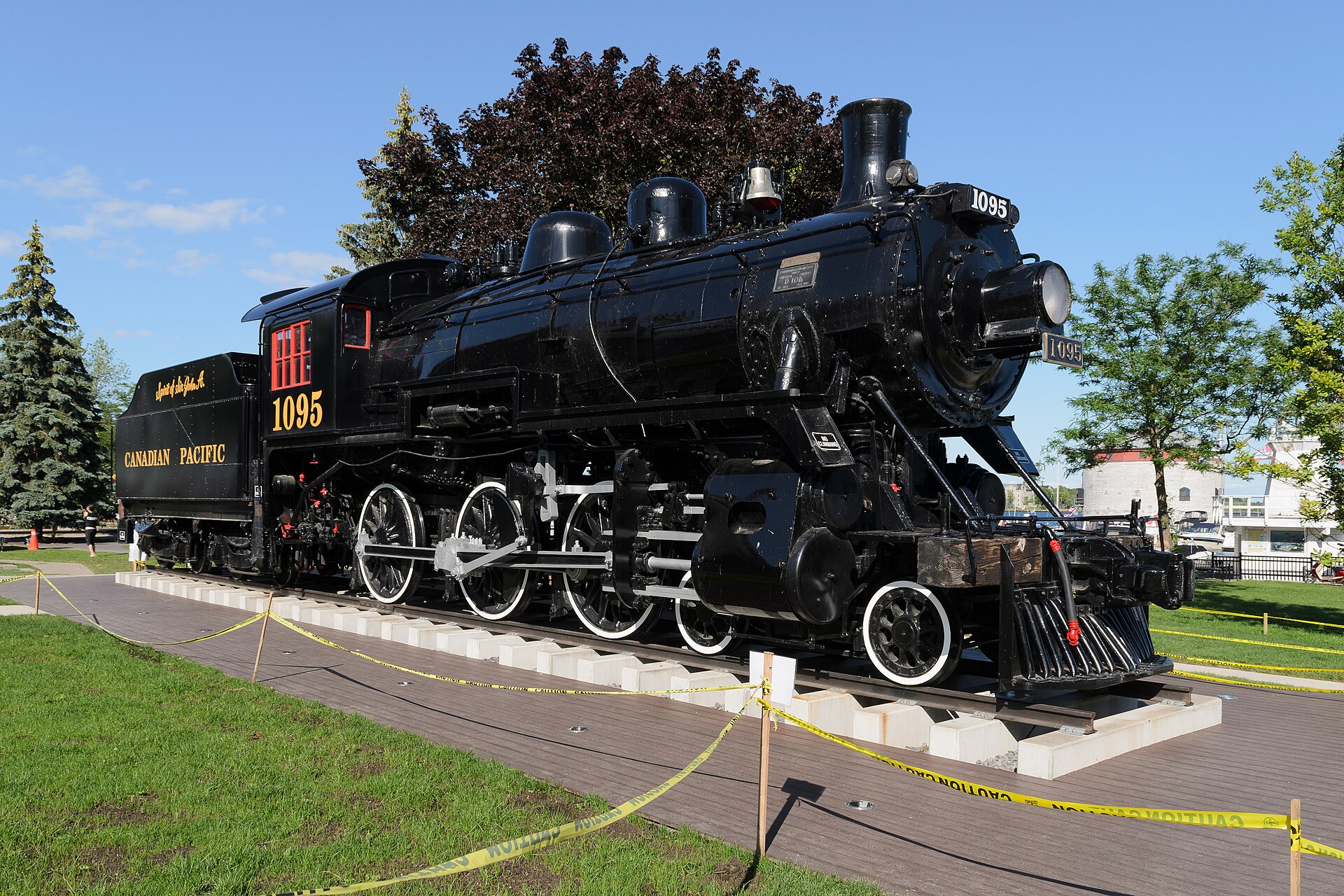
A 1913 Canadian Pacific steam engine, built a few hundred metres away, now the most photographed train in Kingston. Free, open all hours, and very large.
Right in the middle of Kingston’s waterfront, between the marina and City Hall, there’s a big black steam locomotive sitting on a short stretch of track that goes nowhere. It’s Engine 1095, sometimes called “The Spirit of Sir John A.,” and it’s been posing for photos in Confederation Park for more than half a century.
Made in Kingston
It’s easy to forget now, but Kingston used to make things. Big, heavy, loud things. For more than a hundred years the city was home to the Canadian Locomotive Company, whose works sat on the waterfront not far from where 1095 is parked today. The company built more than 3,000 locomotives, steam, electric and diesel, for railways across Canada and beyond.
Engine 1095 rolled out of that shop in 1913. It’s a D10-class 4-6-0 “Ten-Wheeler,” one of the most common types on the Canadian Pacific Railway at the time: four small wheels up front to steer, six big driving wheels to pull, and no wheels at the back. It hauled trains out of Winnipeg, then around Southern Ontario, and finished its working life in Quebec when steam gave way to diesel around 1960.
Why it’s parked here
Confederation Park was built in 1967 for Canada’s centennial, on land that had been a railway yard and, before that, the site of the Market Battery fortification. The stone building behind the engine was the Kingston station of the Kingston & Pembroke Railway, and today it’s the city’s visitor information centre. Bringing a locomotive back to an old rail yard was a nice touch, and it was named “The Spirit of Sir John A.” for the centennial.
Decades outside by the lake took their toll, though, and by the 2000s the engine was looking pretty rusty. A volunteer group formed in 2011 to save it, the city and local tradespeople pitched in, and the engine was restored, moved onto a new foundation, and rededicated on July 1, 2013, a hundred years after it was built. It looks better now than most of us will at a hundred.
What to expect
- Up close. Walk right up beside the driving wheels, which are about as tall as an adult, and take in the rods, bell, cab and coal tender.
- The story. Information panels nearby tell you about the engine, the Canadian Locomotive Company, and the restoration.
- The setting. Flowerbeds, benches and the marina all around, with City Hall across the street.
Friendly tips before you go
- It’s free and always there. You can visit any time, day or night. It looks great in the evening light.
- Kids love it. Few things impress a four-year-old like a wheel bigger than their parent.
- Grab a map while you’re there. The visitor centre in the old station has maps, event listings and staff who know the city.
- More trains nearby. If 1095 has you hooked, the PumpHouse museum down the waterfront has more steam engines and a famous model train collection.
-
Qué hacer
Engine 1095
In Confederation Park, across from City Hall.
-
Sitios históricos Limestone city hall built in the 1840s, when Kingston was Canada’s first capital. A National Historic Site on Springer Market Square, with tours.
Kingston City Hall
Right across Ontario Street.
-
Qué hacer Historic steam museum and discovery centre in Kingston highlighting industrial heritage and science exhibits.
PumpHouse
Home to more steam engines and model trains, a short walk west.